The Lake Mývatn Winter Tour From Akureyri

A Lake Mývatn winter tour runs a shorter list for better light. Between November and March the lake freezes at the edges, the lava wears snow, the midges are five months away and half the roads around Krafla sit under drifts. Saga Travel keeps the classic circuit running through all of it at $182.19, rated 4.82 from 56 reviews. Daylight is the real constraint: on 15 December the sun is up for barely three hours, which is why a winter departure covers fewer stops and gives you better light at every one of them.
The Winter Trip at a Glance
Check Winter Dates
Live availability for the Saga Travel winter departure. Fewer operators run between November and March, so the calendar thins out rather than the seats.
What Winter Changes
The light
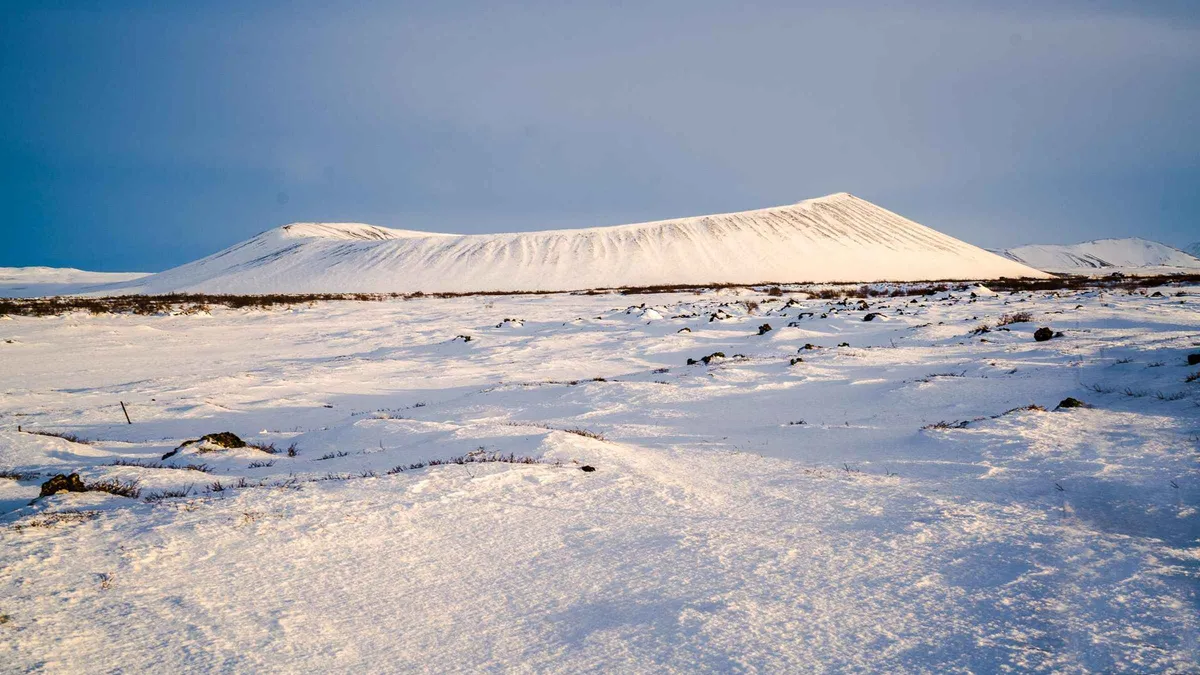
Winter thins the list of Lake Mývatn day trips down to a handful, and this is one of them. At 65.6 degrees north the sun clears the horizon for about 4.6 hours in mid January and 3.2 in mid December. Both ends of that are golden, since the sun never climbs far enough to go harsh.
A six-hour tour leaving mid-morning therefore spends most of its outdoor time in light that photographers pay to chase in summer. By mid February you are back to 8 hours, and by mid March to 11.4.
What closes
The road up to Krafla and the Víti crater shuts under snow and stays shut into late spring, so the caldera comes off every winter itinerary. Lofthellir, the ice cave east of the lake, runs from May to October and is out too. The unpaved tracks around the lake go unplowed.
Route 1 and road 848 stay open and cleared.
| Sight | Winter access | Note |
|---|---|---|
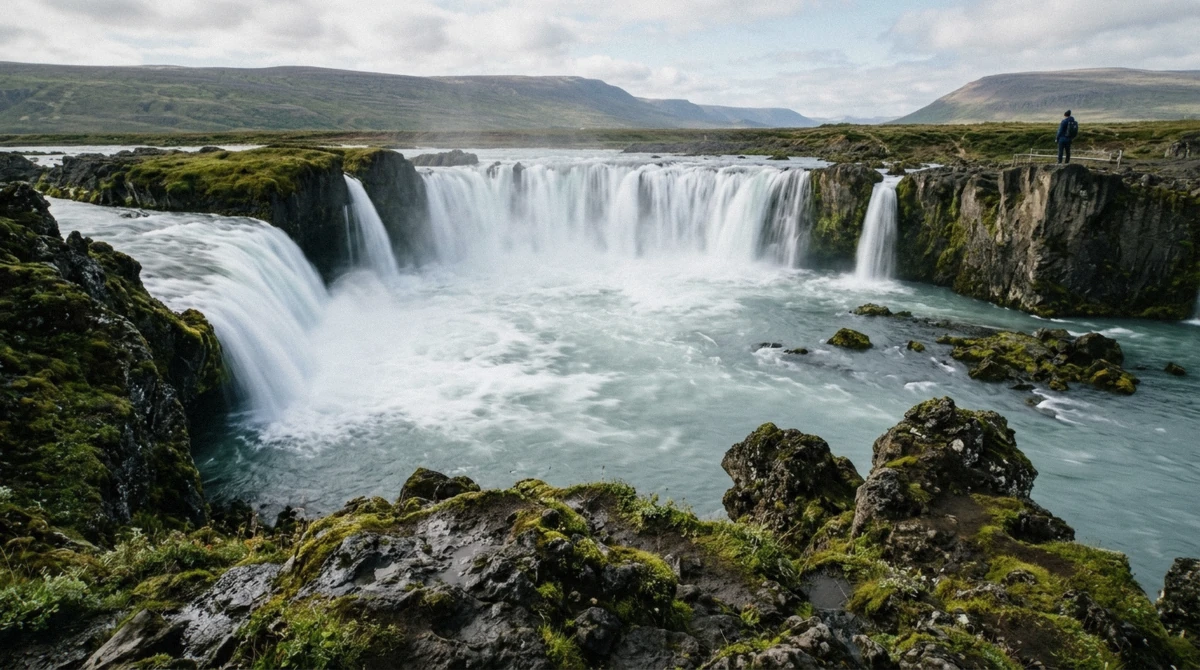
| Goðafoss | Open all year | Icy steps on the bank, hold the rail |
| Skútustaðagígar | Open | Snow flattens the crater shapes |
| Dimmuborgir | Open | Trails packed and slippery, spikes help |
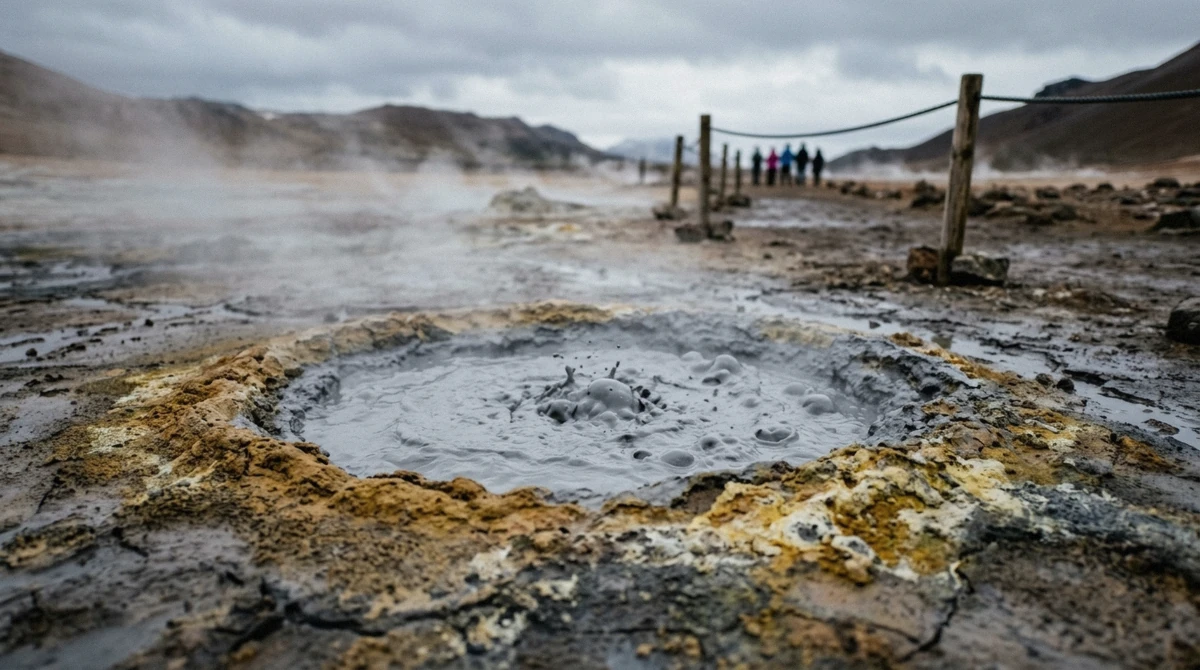
| Hverir | Open | Steam is at its most dramatic in the cold |
| Grjótagjá | Usually open | Depends on the access track |
| Krafla and Víti | Closed | Road under snow into late spring |
| Lofthellir cave | Closed | Guided season runs May to October |
What gets better
No midges, for one, which removes the single most common complaint about the lake. Steam at Hverir stands taller against cold air. The geothermal baths at Jarðbaðshólar, now trading as Earth Lagoon, stay open to 23:00 with nothing between them and a dark northern sky.
And the whole basin empties: the same Dimmuborgir trail that holds four coaches in July holds one minibus in February.
Why the tour still runs when the caldera does not
Route 1 is a priority plowing route, so the road east from Akureyri stays open through almost anything short of a storm warning. Road 848 around the lake is cleared behind it. That is why the classic ring survives the cold months while Krafla, on a minor road nobody plows until spring, does not.
The practical consequence is that a winter departure is not a reduced version of the summer one at four of its stops. Goðafoss, Dimmuborgir, Hverir and the pseudo-craters are all reached the same way, on the same surface, with the same amount of time on the ground. What changes is the light budget and the number of layers.
Operators cancel for wind rather than for snow. A forecast over about 20 metres per second closes the pass east of the lake, and when that happens the departure moves rather than runs badly. If your stay is three nights, book the first suitable date rather than the last.
Aurora, Honestly
September to April, and never a promise
Darkness, clear sky and solar activity all have to line up. Mývatn gives you the first for free from mid afternoon, and it sits far enough from any town that light pollution is not a factor. Cloud is the variable that ruins it. Nobody sells this day tour as an aurora trip, and any operator that guarantees lights is selling something they do not control.
The practical move is to book the day tour for the sights and stay a night at Reykjahlíð, or take a late slot at the lagoon, where you can wait in 38°C water instead of standing in a car park at minus 6°C.
Temperatures to plan for
Reykjahlíð averages minus 1.8°C for a January high and minus 8.4°C for the low, with an annual mean of 1.4°C. The cold is dry and manageable. Wind on the exposed ground at Hverir and on the Goðafoss bank is what actually decides whether you last twenty minutes or five.
What a winter day actually looks like
Departure lands mid-morning because there is no point leaving earlier. In January the sun clears the horizon around 11:00 and is gone by 15:30, so the six hours are built around that window rather than against a clock.
The drive east runs through country that looks different in every month: black lava under snow, steam standing off the geothermal ground, the lake frozen at the edges and open in the middle where the warm springs feed it. Stops shorten, because standing at Hverir in a minus 6°C crosswind is a fifteen minute activity rather than a forty minute one, and the guide reads the group rather than the schedule.
What you notice most is the absence of other people. The Dimmuborgir car park holds four coaches in July. In February it holds your vehicle, and the trails have one set of footprints on them.
Booking and cancellation in the cold months
Departures thin out from November, which changes how you book. Fewer operators run, so a cancelled date may not have a replacement the next day, and the calendar rather than the seat count is the constraint.
Everything on this page cancels free up to 24 hours ahead and takes no payment at booking. Use that. Book the first suitable date of your stay rather than the middle one, so a weather cancellation still leaves you room to try again. Operators cancel for wind and road closures rather than for cold, and when they do, the refund is automatic rather than a negotiation.
What the winter reviewers report
The sample is small and skews positive, with 4.82 from 56 ratings. Joe, travelling in February 2024, named his guide and wrote that the sights were worth it and the guide went out of his way. Dennis, in a September shoulder month, made the point that a lot gets seen without needing to drive yourself, which is the whole argument for a guided winter day.
The one recurring criticism, from a visitor in August, was time between sites rather than the sites themselves. That complaint gets sharper in winter, when the light budget is smaller. Ask at the start which stop the guide plans to give the most time to, and say if you would rather trade one for another.
Included and Not Included
In the price
A fully guided day with transport from Akureyri, running the classic circuit as far as conditions allow. Entry to the sights costs nothing in any season.
- Return transport from Akureyri on Route 1
- Guide with commentary on the geothermal ground and the geology
- The core stops: Goðafoss, the lake, Dimmuborgir and the geothermal field
- Free cancellation up to 24 hours before departure
Not in the price
Food and drink. Entry to the geothermal baths, if the group stops there, from 7,900 ISK for an adult. Traction spikes for your boots, which cost little in Akureyri and turn the packed trails at Dimmuborgir from a hazard into a walk.
What to Wear Between November and March
The list that matters
Nothing exotic, and no single item does the job on its own.
- A windproof shell over a warm mid layer, since wind is the problem rather than temperature
- Waterproof boots with real grip, plus slip-on traction spikes
- Hat and gloves you can work a camera in
- Swimwear and a towel in the day bag if the baths are on your plan
- A power bank, because cold drains phone batteries fast at Hverir
Driving yourself instead
Route 1 is plowed and open, and plenty of people make the drive in winter. What changes is the margin: ice on the pass east of the lake, wind that closes roads at an hour's notice, and daylight that runs out before you have finished the loop. Check road.is on the morning rather than the night before.
If the forecast is ugly, the guided day is the version that still happens.
The Winter Route
East from Akureyri on Route 1, 100 km to Reykjahlíð, then as much of road 848 as the conditions allow.
Who This Suits
Come in winter if
You want the basin to yourself and you can live with a short day.
- Photographers: three hours of golden light and steam against cold air
- Anyone who reacts badly to insects, since the midges are gone
- Aurora hunters staying a night or two at the lake
- Travellers who would rather not drive icy roads themselves
Come in summer instead if
Krafla, the Víti crater and Lofthellir are on your list, or you want the full choice of departures. Between June and August every operator runs, which is where the port excursions and the minibus tour with Grjótagjá come in. The full comparison of Lake Mývatn trips sits on the homepage.
Winter Questions
Is Lake Mývatn worth visiting in winter?
Yes, with one adjustment: expect fewer stops and much better light. Goðafoss, the pseudo-craters, Dimmuborgir and Hverir all stay open and the crowds disappear. Krafla and the Víti crater do not, since the road up sits under snow into late spring. Month by month sets out what else changes.
How much daylight is there?
About 3 hours 15 minutes in mid December, 4.6 hours in mid January, 8.1 in mid February and 11.4 by mid March. A six-hour tour leaving mid-morning uses nearly all of it, and the low sun means the light is good from start to finish.
Can you see the northern lights on this tour?
The season runs September to April and the sky over Mývatn is as dark as Iceland gets, but a daytime tour is not an aurora trip. Stay a night at Reykjahlíð, or take a late slot at the geothermal baths, which stay open until 23:00.
Is the road to Mývatn open in winter?
Route 1 is plowed and open year round, along with road 848 around the lake. The Krafla road and the unpaved tracks are not. Wind and drifting snow close sections at short notice, so check road.is on the morning you travel.
Are there midges in winter?
None. They hatch from June, peak through July and August, and are gone by early September. Anyone who dreads insects should book between October and May and skip the head net entirely.
Can you use the geothermal baths in winter?
Yes, and it is the best season for it. The lagoon at Jarðbaðshólar, now trading as Earth Lagoon, holds 36 to 40°C and runs to 23:00, with adult entry from 7,900 ISK. The tour that finishes in the water is the one that builds it into the day.
What Travellers Wrote
Great day out with our guide Rainier, he was very knowledgeable and went out of his way to help us if we needed it, the sights are amazing, can't recommend highly enough!
Very interesting geology and landscape, very varied. A lot to see, without needing to drive oneself. Must do the hot spa experience.
We had rain and wind but despite the cold the guide was informed and I marveled at the landscape. It is majestically surreal.